


Circadian lighting isn't one setting you slap across the whole house. Every room has its own job, and the right light depends on what happens in that room and what time of day it is.
A home office needs bright, focus-friendly light during work hours. A nursery needs almost the opposite, nearly all the time. Treating every room the same misses the point. The whole idea depends on the contrast between spaces and between day and night, not one "healthy" color temperature you set once and forget.
Before we get into each room, it helps to understand the basic idea in plain terms. Light color is measured in Kelvin (K). Think of it as a dial that runs from warm, amber, campfire-like light at lower numbers, around 1800K–2500K, up to bright, blue-white daylight at higher numbers, around 5000K–6500K.
Your body reads blue-rich light as a signal that it's daytime, which can be useful in the morning but less desirable close to bedtime. Warm, amber light signals nighttime. Once you have that dial in your head, the room-by-room advice below will make a lot more sense.
Here's how to think it through, room by room.
Bedroom: Where the Stakes Are Highest
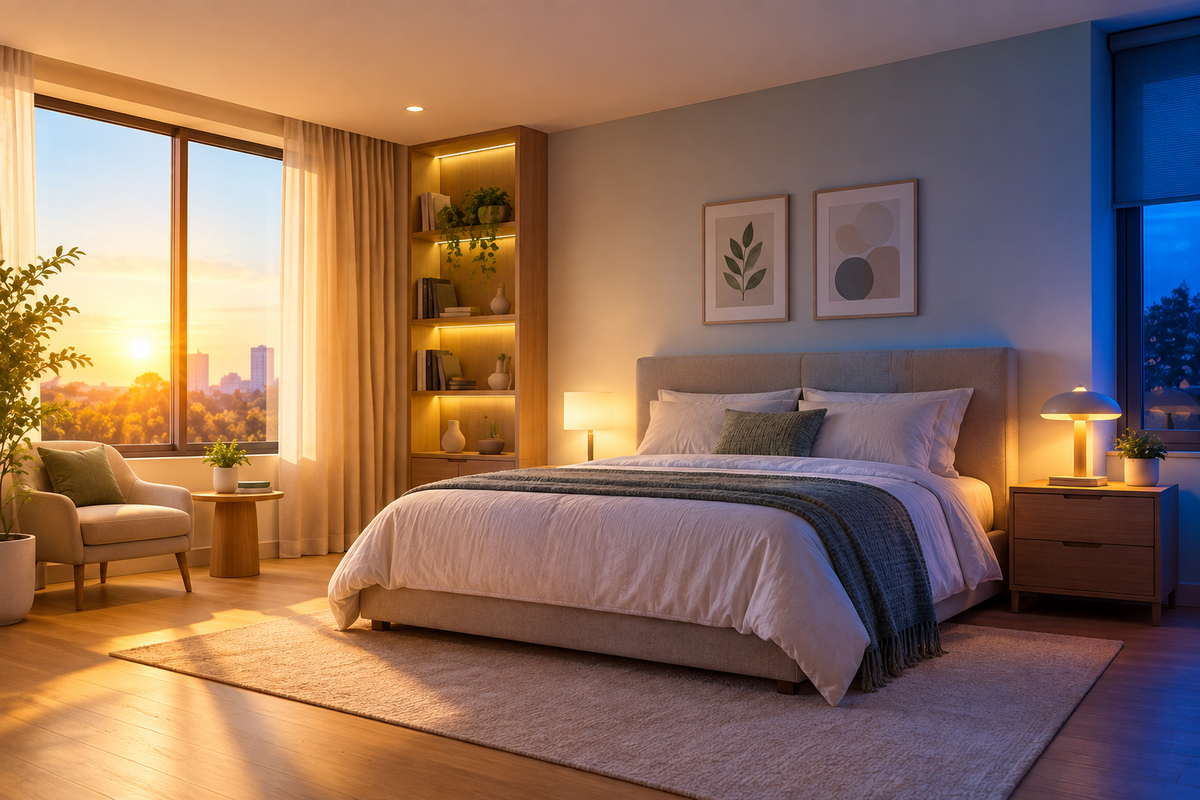
Start here — it's where nighttime lighting matters most for creating a comfortable environment for sleep. Evening and nighttime lighting should generally sit around 1800K–2200K: a deep amber tone with very little blue content, and preferably at a lower brightness.
A common mistake is leaving overhead lighting at 2700K–3000K "warm white" at 10pm. It looks cozy, but it still produces more blue-rich light than a deeper amber night setting. Plenty of people assume any bulb labeled "warm" is doing the job, but there is a meaningful difference between standard warm-white lighting and a dedicated nighttime setting.
During the day, bedroom lighting can shift brighter and more neutral, around 3500K–4000K, for getting dressed or making the bed. What matters is that the lighting actually changes between day and night. A single fixed "warm" bulb left on the same setting around the clock doesn't create the same contrast.
Living Room: The Room Most People Forget About
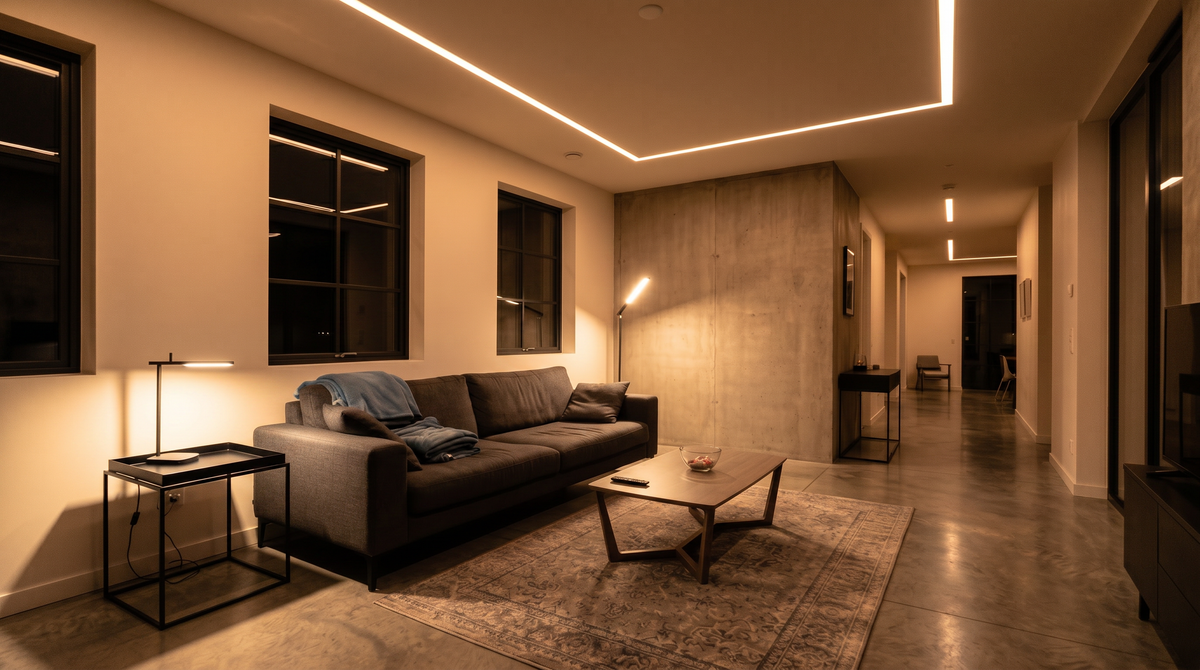
This is where most households spend their evenings, which makes it almost as important as the bedroom — and one of the most commonly overlooked rooms.
A balanced 3000K–3500K works well for many evening activities: warm enough for a relaxed atmosphere while remaining comfortable for reading or watching TV.
You don't necessarily need to go as deep as bedroom-level 1800K lighting. The living room is a transition zone rather than the final wind-down space. A static cool-white 4000K+ light left on throughout the evening, however, may make it harder to create that gradual transition toward nighttime.
One easy habit is to treat the light change as part of your evening routine. Shifting the living room warmer around dinnertime gives you a gradual transition rather than waiting until you're already heading to bed.
Kitchen: Bright When You Need It, Warm When You Don't
Kitchens need genuine brightness for food preparation. A bright, neutral-to-cool 4000K–5000K setting can support visibility during the day and early evening. You still need to see what you're chopping, cleaning, and preparing.
The issue is keeping that same bright, cool setting late into the night. If you're cleaning up after dinner or packing lunches, warming the lighting down can reduce unnecessary exposure to bright, cool light close to bedtime.
Home Office: The One Room Where Brighter Is Better
This is one of the few rooms where brighter, cooler light can be useful rather than a tradeoff. Around 5000K–6000K during work hours can create a bright, daytime-like environment that supports visual tasks and alertness.
If you work into the evening, consider shifting toward a warmer 3500K–4000K setting. This creates a clearer distinction between your daytime work environment and the evening period when you're preparing to wind down.
If your job regularly keeps you at a desk after sunset, lighting changes can be one of the easiest environmental adjustments to make because you can control them without changing your entire workspace.
Nursery: A Gentle Approach for Nighttime
Nurseries can benefit from a dedicated, very dim, deep-amber source for nighttime feedings, diaper changes, and settling a child back down. Around 1800K or lower is commonly used for this type of nighttime lighting.
Research has found differences in how children and adults respond to nighttime LED exposure, including stronger melatonin suppression in children under some tested conditions. This is one reason many parents prefer keeping nighttime nursery lighting dim and warm.
A separate low-output night light can work better in practice than simply dimming the main overhead fixture. It removes the temptation to turn on a much brighter light during a 2am wake-up.
Bathroom: The 2am Danger Zone
Bathrooms need more contrast than almost any other room in the house. Morning bathroom lights can be bright and cool to support your wake-up routine, while nighttime lighting can be much warmer and dimmer.
A bright overhead light during a 2am bathroom trip can create a sudden burst of bright light when your body is otherwise in nighttime mode. A dim, warm night light provides enough visibility without requiring you to turn on the main fixture.
Putting It All Together: Your Room-by-Room Cheat Sheet
| Room | Daytime | Evening / Night |
|---|---|---|
| Bedroom | 3500K–4000K | 1800K–2200K |
| Living Room | 3500K–4000K | 3000K–3500K |
| Kitchen | 4000K–5000K | 3000K–3500K |
| Home Office | 5000K–6000K | 3500K–4000K |
| Nursery | 3500K as needed | 1800K or dedicated night light |
| Bathroom | 4000K–5000K | Dim amber night light |
Where to Start: A Simple Rollout Plan
You don't have to change every bulb in your home at once. A gradual approach is easier and usually more practical.
- Start with the bedroom and create a warmer, dimmer nighttime environment.
- Adjust the living room and kitchen for the evening.
- Add dedicated night lights to bathrooms, hallways, and the nursery.
- Adjust the home office if you regularly work after sunset.
Kind Lights uses the same THRIVE / FLOW / REST system with different bulb types, including A19 bulbs for lamps and ceiling fixtures, BR30 bulbs for recessed lights, E12 bulbs for smaller fixtures, and a retrofit recessed option.
This makes it possible to follow a consistent day-to-night lighting routine across different rooms and fixture types.
For more information, see our guide on how to choose the right circadian light bulb .
Share:
How Should I Use Circadian Lighting Throughout the Day?
Best Lighting for Reading at Night: What to Know