

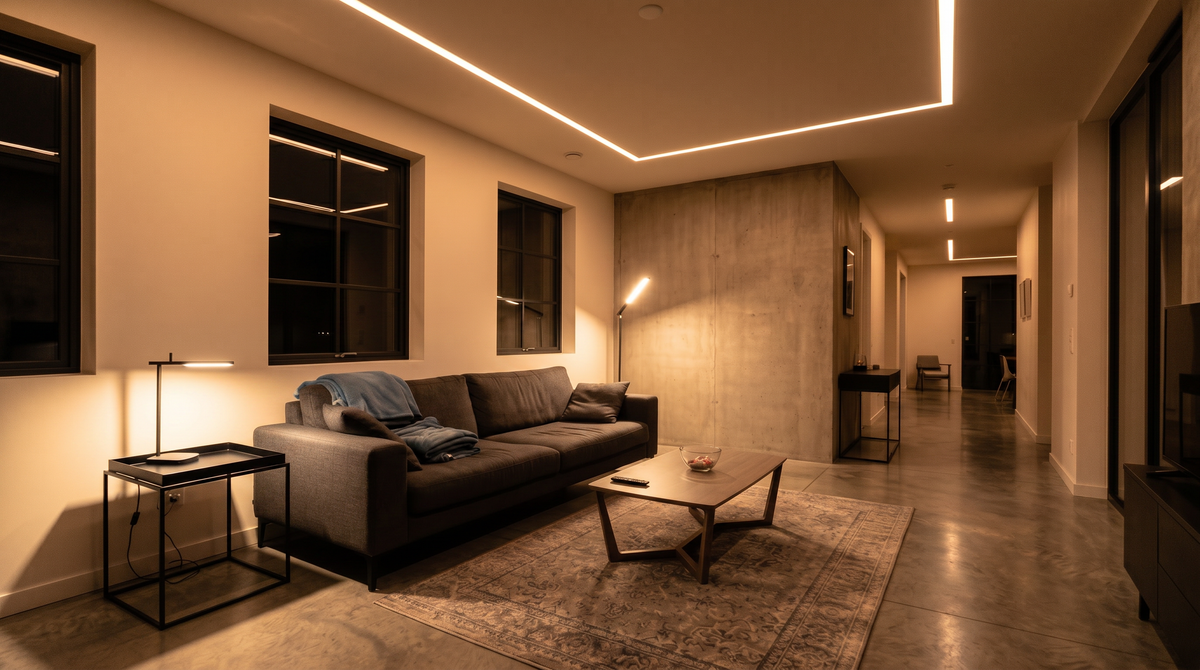

The best lighting for nighttime reading is warm, low-blue light in roughly the 2200K–3500K range — bright enough to read comfortably, but without the blue-wavelength content that disrupts melatonin production. This is a slightly brighter setting than pure sleep-prep lighting (1800K), since reading requires more visual contrast than simply winding down in a dim room.
Reading vs. Sleep: Finding the Right Balance
Pure pre-sleep lighting in the 1800K range recommended for the final stretch before bed is intentionally very dim, which makes it too low-contrast for comfortable reading. Squint at a page under that kind of light for more than a few minutes and you'll likely give up or turn on something brighter.
That's the trap most people fall into: standard bright, cool-white reading lamps (often 4000K–5000K) solve the contrast problem but work against sleep by delivering strong blue-wavelength content right before bed. Research shows blue light suppresses melatonin considerably more than warmer light at comparable brightness, which is the core tension nighttime reading light needs to solve. The goal isn't to pick brightness or warmth, it's a color temperature that gives you both, just in smaller doses than a daytime lamp.
What to Look for in a Reading Light
-
Color temperature: 2200K–3500K. This balances readability with minimized blue content — warmer than a standard reading lamp, but with enough contrast to read comfortably, unlike a very dim 1800K setting.
- High CRI. Text and page contrast render more clearly under a high-CRI bulb (90+), since color and detail accuracy directly affects reading comfort, not just ambiance. A low-CRI bulb can leave a page looking flat even at an otherwise reasonable brightness.
- Directional, task-focused light. A bedside lamp aimed at the page, rather than a bright overhead fixture that lights the whole room, limits overall blue-light exposure to your eyes and keeps the rest of the room dim.
-
Flicker-free driver. Extended close-range reading is exactly the kind of prolonged visual task where flicker-related eye strain and headaches are most noticeable. This matters more for reading than for most other evening lighting uses, simply because of how long your eyes stay fixed on one spot.
How to Set Up Your Reading Light
A bedside lamp or reading light on a warm, mid-range setting — rather than the deepest 1800K "sleep" mode — is generally the better choice specifically for the act of reading. Save the very dimmest, deepest amber setting for the few minutes after you put the book down and turn in.
If your bedroom bulb has multiple modes, the balanced daytime-style setting runs at low brightness, or a dedicated warm mode around 2200K–3500K, tends to work better for reading than the deepest evening mode. The idea is to treat reading as its own distinct phase of the evening: past the point of needing full daytime brightness, but not yet at the point of pure wind-down.
The Simple Takeaway
Nighttime reading light sits in a middle zone warmer and dimmer than daytime lighting, but brighter and more contrast-friendly than true pre-sleep lighting. Getting the color temperature right means you can finish a chapter without paying for it in sleep quality.
For the reasoning behind lower color temperatures at bedtime specifically, see What Color Temperature Is Best for Sleep? For more on why CRI and flicker matter for visual comfort, see Understanding CRI and LED Flicker.

Share:
The Best Lighting for Every Room in Your Home (And When to Use It)