

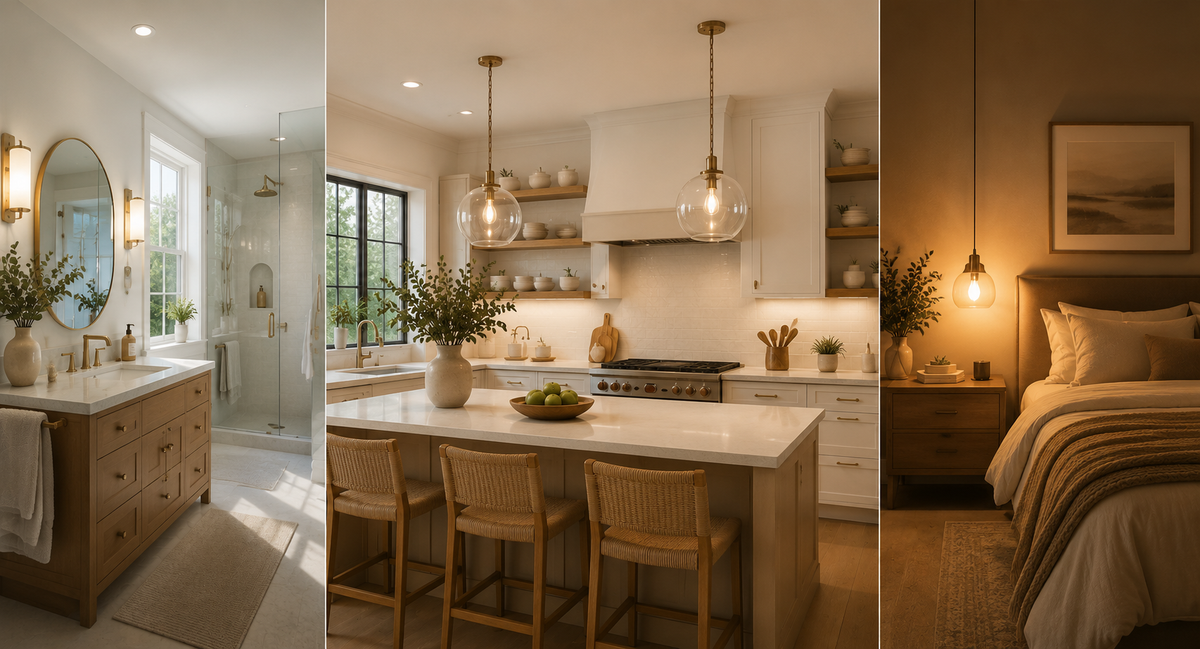
Your body runs on light, not on the clock hanging in your kitchen. Every cell you have follows a roughly 24-hour internal rhythm, and the single strongest cue that keeps that rhythm on schedule is the light hitting your eyes, not caffeine, not your alarm, not what time you "should" feel tired. Circadian lighting is the practice of designing your home's lighting to work with that rhythm instead of against it: bright and blue-toned in the morning, dim and amber in the evening, mirroring the arc of a normal day outside.

Most homes don't do this. A single 3000K bulb burns the exact same color from breakfast to your last scroll through your phone before bed, which means your living room is quietly telling your brain it's still midday long after the sun's gone down. This guide walks through what circadian lighting actually is, why it works, what color temperature makes sense at each hour, and how to set it up room by room, no app, no smart-home hub, no electrician required.
What Is Circadian Lighting?
It's lighting that changes color temperature and brightness over the course of the day to support your circadian rhythm, the internal 24-hour clock that governs sleep, alertness, and a long list of other biological processes. Instead of one static white bulb, circadian lighting shifts from cool, bright, blue-enriched light in the morning and midday to warm, dim, amber-heavy light in the evening, echoing the natural path of sunlight from sunrise to sunset.
The idea isn't new — it's just correcting for something new. For most of human history, light meant bright blue sky by day and firelight or candlelight by night. LED lighting broke that pattern almost overnight. Standard bulbs are engineered for visual clarity and energy efficiency, full stop — nobody was optimizing them for biological timing. So most homes end up lit at one unchanging color temperature no matter what time it is. Circadian lighting is an attempt to bring back the day-night contrast your body still expects, even if your calendar doesn't care.
How Does It Actually Work?
The mechanism runs through a specific set of light-sensitive cells in your eye called intrinsically photosensitive retinal ganglion cells, or ipRGCs. They're not the rods and cones you use to see — their whole job is to measure the color and brightness of the light around you and report it straight to your brain's master clock, the suprachiasmatic nucleus (SCN), tucked inside the hypothalamus. The National Institute of General Medical Sciences has a good plain-language rundown of how the SCN coordinates rhythms across nearly every organ in your body, not just sleep.

ipRGCs are most sensitive to blue light around 480 nanometers. When they pick up blue-rich light, they tell the SCN it's daytime — which suppresses melatonin (your sleep hormone) and supports cortisol, alertness, and focus. Take the blue light away, as with amber or red-shifted light, and that suppression signal fades, letting melatonin rise the way it's supposed to as you head toward bedtime.
That's really the whole mechanism circadian lighting is built on: control the color and intensity of light in a room, and you're directly shaping the signal your eyes send to your circadian clock. For a deeper dive into melanopic lux and how researchers actually quantify a light's biological effect, see our longer breakdown of how circadian lighting works.
What You Can Get From Circadian Lighting
The research on light and circadian health is pretty consistent on a handful of benefits:
You fall asleep faster. Cutting blue light exposure in the evening removes the wavelengths most responsible for delaying melatonin release. A widely cited Harvard Health study found blue light suppressed melatonin for roughly twice as long as green light of the same brightness, and shifted circadian timing by about twice as much.
Mornings feel more like mornings. Bright, cool-toned light early in the day helps reinforce the cortisol awakening response — the natural cortisol spike that helps you feel alert shortly after waking. Human studies on light exposure and this response are summarized in journals like Endocrine Reviews.
Energy feels steadier through the day. A consistent, well-timed light schedule supports what researchers call circadian entrainment — associated with more stable mood and energy, rather than the 3 p.m. crash that tends to follow poorly timed light exposure.
Evenings feel calmer. Warm, low-blue light in the hours before bed doesn't compete with the "wind down" signal you're trying to send your own brain.
Your eyes are just more comfortable. High-CRI, low-flicker bulbs (more on this below) cut down on the eye strain that comes with cheap LEDs and poor color rendering.
What's the Right Color Temperature for Each Time of Day?
Not all light pulls the same weight at every hour. Here's roughly the arc most circadian systems — including our own THRIVE, FLOW, and REST modes — are built around.
| Time of Day | Color Temperature | Light Character | What It's Doing |
|---|---|---|---|
| Early morning (wake–10 a.m.) | 5000K–6500K | Bright, cool, blue-enriched | Clears residual melatonin, supports cortisol and alertness |
| Midday (10 a.m.–4 p.m.) | 4000K–5500K | Bright, neutral-cool | Sustains focus and energy |
| Late afternoon/evening (4–8 p.m.) | 3000K–3500K | Balanced, warm-neutral | Eases the transition without overstimulating |
| Evening wind-down (8–10 p.m.) | 2200K–2700K | Warm, dim | Starts cutting blue exposure |
| Night / pre-sleep (10 p.m.–bed) | 1800K–2200K | Deep amber, very dim | Lets melatonin rise naturally |
This is the same logic behind our own mode system: THRIVE (6000K) for morning energy, FLOW (3500K) for balanced daytime living, REST (1800K) for the wind-down window before sleep, switchable right from your existing wall switch. No app needed. See the full mode breakdown if you want the details, or jump to circadian lighting for different rooms for a room-specific walkthrough.
Okay, But What's the Single Best Color Temperature?
Kelvin numbers are a decent shorthand, but they don't tell the whole story. Lower numbers (1800K–2700K) look warm and amber; higher numbers (5000K–6500K) look cool and blue-white. Two bulbs can share the same Kelvin rating and still have meaningfully different effects on your circadian system, because what actually matters biologically is how much a light's spectrum activates those ipRGCs we mentioned earlier — a metric researchers call equivalent melanopic lux (EML). It's technical, but it's the reason the WELL Building Standard recommends keeping melanopic lux under roughly 50 in the evening and nighttime hours, regardless of what the Kelvin label says.
In practice, for home use, that translates to something simple:
6000K+ for morning energy and focus — this is when you want the strongest melanopic effect.
3500K–4000K for balanced daytime living and work.
1800K–2200K for evening and pre-sleep — the lower the Kelvin, the less blue content and the smaller the melanopic hit.
For more on the research connecting wavelength and color temperature to melatonin suppression, Sleep Foundation's overview of blue light is a solid starting point.
Sleep Is Where This Matters Most
Of everything circadian lighting touches, sleep has the strongest research behind it. In that Harvard-led comparison mentioned earlier, 6.5 hours of blue light exposure suppressed melatonin for roughly twice as long as 6.5 hours of green light at matched brightness, and shifted circadian timing by about double. Because ipRGCs are most sensitive right around that 480nm blue range, warm amber-shifted light in the evening simply avoids triggering that suppression in the first place — which is the whole design logic behind a dedicated low-blue night mode, like our 1800K REST setting built specifically for the hour or two before bed.
A few things follow pretty directly from the research:
- Start dimming and warming your lights 1–2 hours before your actual bedtime — not the moment you climb into bed.
- Skip the bright, cool-white overhead light for late-night bathroom or kitchen trips. A dim amber night light does the job without waking you up further.
- Keep bedroom lighting under roughly 2200K in that last hour before sleep.
Circadian Lighting, Room by Room
One setting for the whole house misses the point — each room does a different job, so the right light differs by space.
| Room | What Works |
|---|---|
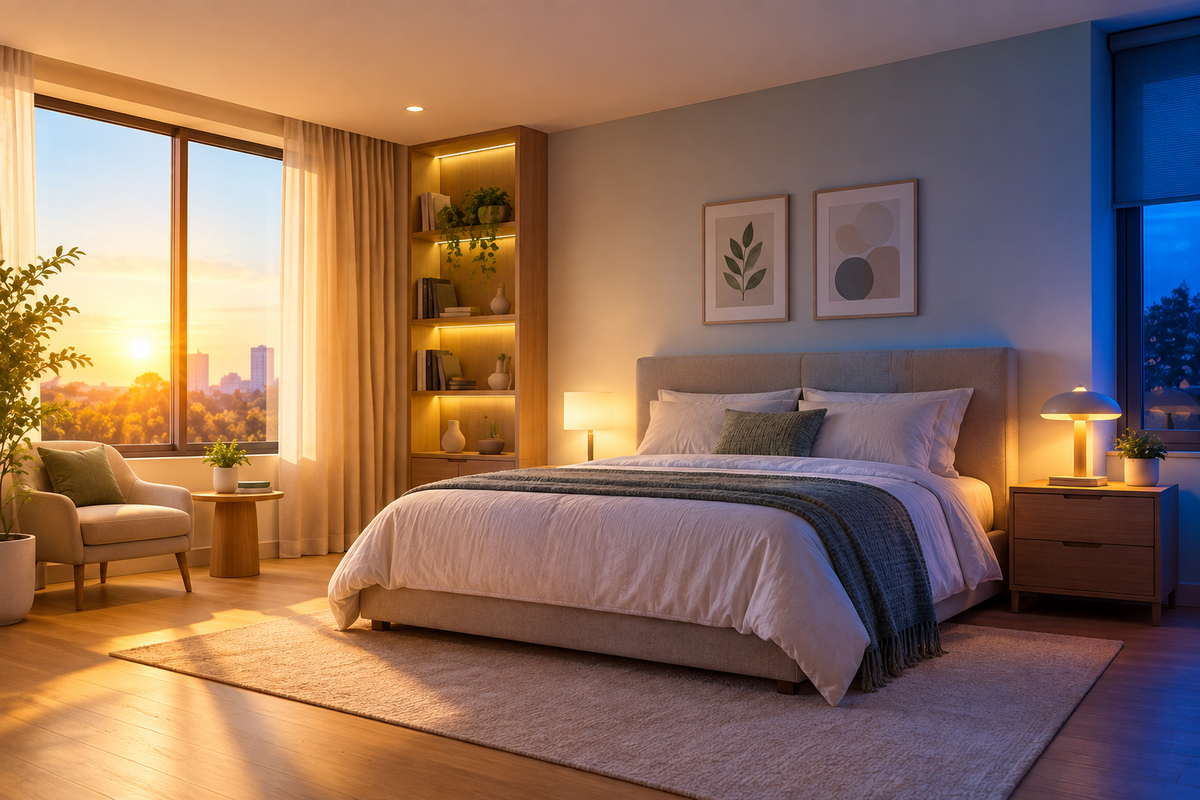
| Bedroom | Warm (1800K–2200K) in the evening; skip bright overhead light after dark |
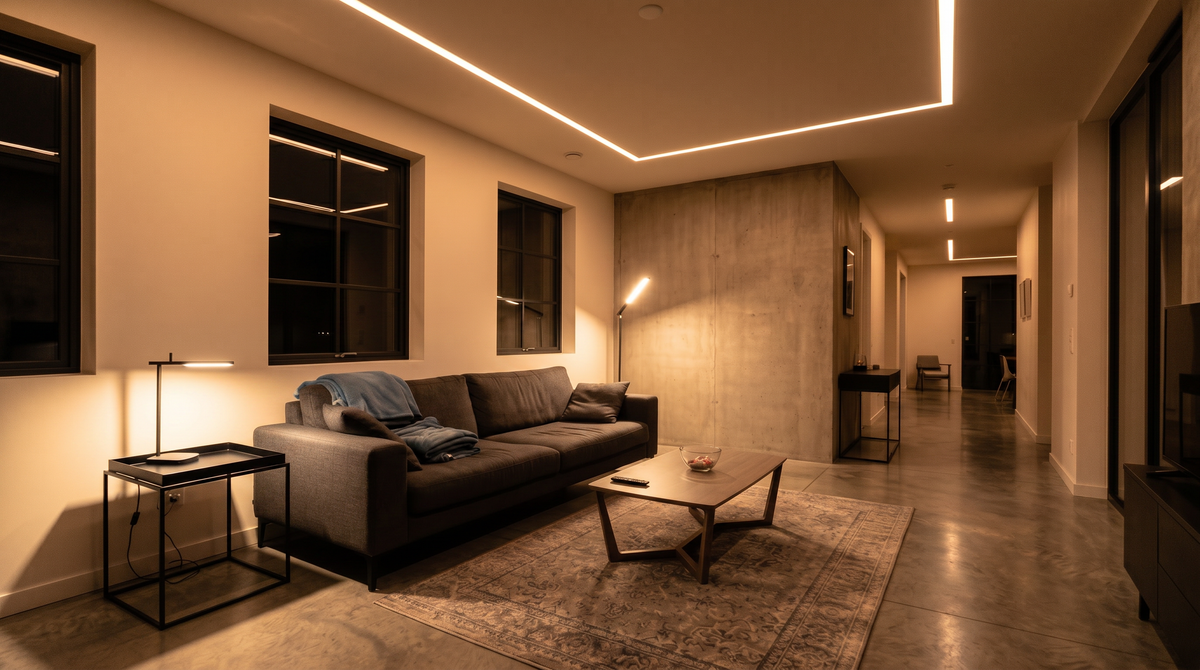
| Living / family room | Balanced 3000K–3500K in the evenings; you don't need cooler light here |
| Kitchen | Bright, neutral-cool (4000K–5000K) during the day, warmed down at night |
| Home office | Cool, bright (5000K–6000K) during work hours to support focus |
| Nursery | Very dim, deep amber (1800K or lower) for night feedings and diaper changes |
| Bathroom | Cool and bright in the morning; a dim amber option for nighttime use |
This is exactly where a lot of single-mode "wellness bulbs" fall short — they focus almost entirely on the bedtime end of things and ignore that a kitchen, an office, and a nursery all need something different at different hours. If you want fixture-by-fixture detail, including which bulb fits which socket, circadian lighting for every room covers it.

How to Actually Pick a Bulb
Marketing claims aside, four specs actually determine whether a circadian bulb does what it says:
Color temperature range. Look for a bulb that genuinely spans the full arc — a true daytime mode (5000K+) and a true evening mode (2200K or below) — not just "warm" and "warmer."
CRI (Color Rendering Index). A CRI of 90+, ideally 95+, means colors, skin tones, and wood finishes look the way they should instead of washed out or flat. A lot of budget LEDs sit around 80–85.
Flicker. Cheap LED drivers flicker at frequencies that can cause eye strain and headaches even when you can't consciously see it. Look for bulbs explicitly engineered to be low-flicker.
Control method. App-based and hub-based systems add setup friction and one more thing that can break or get forgotten. A bulb that cycles modes from your existing wall switch just works, in any room, without new wiring or another account to manage.
Our A19, BR30 floodlight, E12 candelabra, and recessed retrofit bulbs are built around all four of these: THRIVE/FLOW/REST modes switchable with no app, 95+ CRI, and a flicker-free driver, so one bulb drops into an existing lamp, ceiling fixture, or recessed can with no new hardware. For more on what CRI and flicker actually mean in practice, see understanding CRI and LED flicker.
Regular Lighting vs. Circadian Lighting
| Regular LED Bulb | Circadian Lighting | |
|---|---|---|
| Color temperature | Fixed all day | Changes with time of day |
| Melatonin impact at night | Often suppresses it (typically 2700K–4000K, still blue-enriched) | Designed to minimize suppression in the evening |
| Morning alertness support | None — same light all day | Bright, cool mode built to support wakefulness |
| CRI | Often 80–85 | Often 90–95+ on purpose-built bulbs |
| Flicker engineering | Inconsistent, often unaddressed | Usually a design priority |
| Setup | Screw in and done | Screw in; some need an app or hub, others work from existing switches |
The real difference isn't brightness, and it's not even warmth, it's timing. A single warm 2700K bulb left on all evening actually does more for your circadian rhythm than a cool 5000K bulb burning at night, but it still won't give your body the bright, activating light it wants in the morning. Real circadian lighting handles both ends of the day, not just one.
Setting It Up Without Rewiring Your House
You don't need an electrician for this. A reasonable order of operations:
- Start with the bedroom. This is where blue light at night does the most measurable damage, so it's the highest-impact room to fix first.
- Move to the rooms you spend evenings in — living room, kitchen — since that's where most of your pre-bed hours actually happen.
- Add a dedicated night light for hallways, bathrooms, and nurseries, so you're never flipping on a bright overhead at 2 a.m.
- Leave home offices and kitchens bright and cool during working or cooking hours. Circadian lighting isn't about dimming everything all the time — it's about matching light to the task and the hour.
- Pick a control method you'll actually stick with. If an app-based system means your lights revert to "whatever they were last" because nobody opens the app, a switch-based system that cycles modes automatically will get used far more consistently.
Mistakes People Make With Circadian Lighting
Only fixing bedtime. Warm bulbs in the bedroom help, but if you skip bright morning light, you're leaving half the benefit on the table. Morning light exposure matters just as much for your daily rhythm as avoiding evening light does.
Assuming "warm white" is the same as true evening light. Standard 2700K–3000K warm-white LEDs still carry meaningfully more blue content than a purpose-built 1800K–2200K evening mode.
Relying on dimness alone. A dim cool-white light can still affect melatonin. Color temperature matters as much as brightness does.
Overengineering it. Elaborate app schedules that need daily manual adjustment tend to get abandoned within a few weeks; simpler systems get used, complicated ones get ignored.
Ignoring CRI and flicker. A bulb can hit the "right" Kelvin number on paper and still cause eye strain if it flickers or renders color poorly. Both matter for comfort, not just for the sleep-science angle.
Using bright overhead light for nighttime bathroom trips or feedings. This is probably one of the biggest — and most fixable — sources of unwanted evening light exposure in many homes.
Common Questions
What color temperature is best for sleep?
Generally 1800K–2200K — a deep amber tone with minimal blue content.
Does blue light actually affect sleep?
Yes. Research consistently shows blue light can suppress melatonin more strongly, and for longer, than other wavelengths at comparable brightness. See Harvard Health's summary of the underlying study.
What's the difference between 1800K and 2700K?
1800K is a deeper amber with less blue content, closer to firelight. 2700K is standard "warm white" and still carries more blue wavelength content than a dedicated evening mode.
What's the best lighting for a bedroom?
Warm, dim, and adjustable — bright enough for daytime tasks, but able to shift down to 1800K–2200K in the evening.
How should I use circadian lighting throughout the day?
Bright and cool in the morning, balanced at midday, warm and dim in the hour or two before bed.
What's the best lighting for reading at night?
Something warm and low in blue content, but still bright enough to actually read by, without flooding the room with alerting light.
Share: