

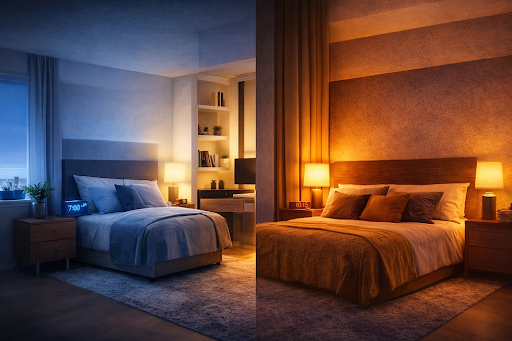

Yes, amber light is good for sleep when it is dim. Amber light at about 1800-2200K contains very little blue light, so it has a small effect on melatonin compared with white or blue light. It lets you see in the evening without strongly signaling daytime to your body clock.
What is amber light?
Amber light sits at roughly 585-620nm, between yellow and red. Candle flames, fire and dedicated amber bulbs and night lights produce it. In kelvin terms it is around 1800-2200K, the warmest light most people use at home.
Is red light good for sleep?
Dim red light is the light color least likely to disrupt sleep, because it stimulates the body clock less than blue or white light. However, research showing that it improves sleep on its own is limited. Use it as a low-impact night light rather than a sleep treatment.
The body clock responds most strongly to blue wavelengths and room light before bedtime suppresses melatonin. One small study of athletes reported better sleep quality after evening red-light exposure, but larger studies are needed.
Amber vs red vs warm white
| Feature | Amber | Red | Warm white, 2700K |
|---|---|---|---|
| Melatonin effect | Very low | Lowest | Low if dim |
| Visibility | Good | Lower; colors look dark | Best |
| Best use | Last hour, night light | Night feeds, night walks | Evening rooms |
How to use amber light for sleep
- Switch to amber or 2200K bulbs in the last hour before bed.
- Keep the light low, beside or behind you.
- Use an amber night light instead of the main light at night.
- Turn lights off or very low when you go to sleep.
Where amber light works best
For more on setting up a child's room, see our guide to nursery lighting.
| Room | How to use amber light | Brightness |
|---|---|---|
| Bedroom | Bedside lamp in the last hour before bed | Low |
| Bathroom | Night light for late-night visits | Lowest |
| Hallway | Plug-in or motion-sensor night light | Lowest |
| Nursery | Night light for feeds and changes | Lowest |
Amber light vs darkness
Amber light is a good compromise when you need to see, but it is not better than darkness for sleep itself. Brightness still matters: a bright amber light will have a larger effect than a very dim one. Use amber as a tool for evenings and night-time visits, then keep the bedroom dark while you sleep.
Common mistakes
- Assuming amber makes any brightness safe for sleep.
- Using amber-tinted screens instead of turning screens off.
- Buying "warm" bulbs that are actually 3500K or higher. Check the kelvin figure.
- Placing the light where it shines directly at your face.
Rules of thumb
- Use amber in the last hour before bed and for night visits.
- Keep it dim and out of direct view.
- Choose darkness or the lowest amber level when you are ready to sleep.
Frequently asked questions
Is amber better than red for sleep?
Red has the least effect on the body clock, while amber is easier to see by. Both are good; choose the one that lets you work comfortably at the lowest brightness.
Can I use amber light all evening?
Yes, if it is dim. Amber suits the last hour or two before bed, while 2700K warm white works earlier in the evening.
Should I sleep with an amber light on?
Darkness or a very dim light is best. If you need a light, keep it amber or red, low and out of direct view.
Share:
Best Light Color for Sleep: Amber, Red or Warm White?