

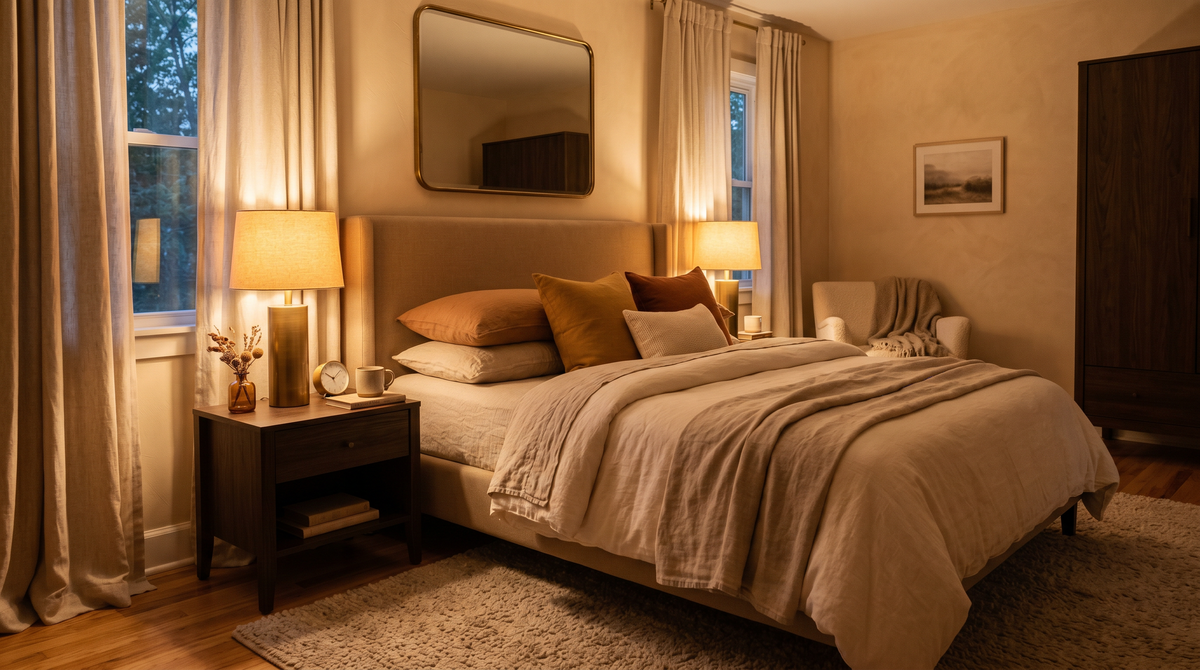

The best bedroom lighting should change throughout the day: THRIVE for wake-up, FLOW for daytime activities, and REST for the evening wind-down. This creates a more natural progression from bright morning light to comfortable daytime illumination and finally to warm, dim evening light.
Why You Need Different Light During the Day and Night
The bedroom is used very differently at different hours: getting dressed and making the bed in the morning versus winding down and sleeping at night. Light exposure is the primary cue your body uses to time melatonin and cortisol release, through specialized retinal cells most sensitive to blue-wavelength light.
A bedroom lit at a single warm-white color temperature all day provides no morning "wake up" signal. And if that fixed color sits in the 2700K–3000K range, the standard for most "warm" household bulbs, it still carries more blue content than a dedicated evening mode would in the hours before bed. Warm-looking isn't the same as low-blue; the difference between 2700K and 1800K is meaningful for melatonin, even though both read as "cozy" to the eye.
What Bedroom Lighting Should Look Like
Wake-up and morning: Start the day with THRIVE, the brightest and coolest of the three settings. This provides a stronger, more energizing light environment when you wake up and get ready for the day.
Daytime: After the morning, switch to FLOW, a bright, neutral-toned setting around 3500K–4000K. This is suited to everyday daytime activities such as getting dressed, working, reading, or making the bed without making the bedroom feel overly cool.
Evening wind-down (1–2 hours before bed): As the day transitions toward nighttime, switch to REST, the warmest and dimmest setting at around 1800K–2200K. Warmer, lower-intensity light is better suited to the evening environment than bright, blue-enriched lighting.
Overnight: Avoid bright overhead lighting for occasional nighttime use. If you need to get up, a dim amber night light can provide enough illumination without turning on the bedroom's main light. Switching on a bright overhead fixture at 3 a.m. introduces much more light than is necessary for a quick nighttime task.
How to Set Up Your Bedroom Lighting
The simplest way to achieve this without smart-home complexity is a bulb built with distinct modes for each part of the day, switchable from the wall rather than a single-color bulb or an app-based system that requires manual adjustment every night. An app can technically do this, but it depends on remembering to change it; a wall-switchable mode removes that friction.
Kind Lights' THRIVE, FLOW, and REST modes are designed to follow this daily progression:
- THRIVE: Use when you wake up and start your morning.
- FLOW: Use throughout the rest of the daytime for normal bedroom activities.
- REST: Switch to this warm, dim setting during the evening wind-down and before bed.
The modes are switchable from your existing wall switch, so there is no app or hub required.
The Simple Takeaway
Bedroom lighting works best when it mirrors the natural arc of the day rather than staying at one fixed setting. Start with THRIVE in the morning, move to FLOW during the daytime, and transition to REST in the evening.
The goal is not simply to make the bedroom look "warm." It is to create a clear progression from brighter morning and daytime light to warmer, dimmer evening light. This three-mode approach makes that transition simple and repeatable.
For the reasoning behind the specific 1800K–2200K range, see What Color Temperature Is Best for Sleep? For how bedroom lighting fits alongside the rest of the house, see Circadian Lighting for Different Rooms.

Share:
How Circadian Lighting Works for Better Daily Rhythms