

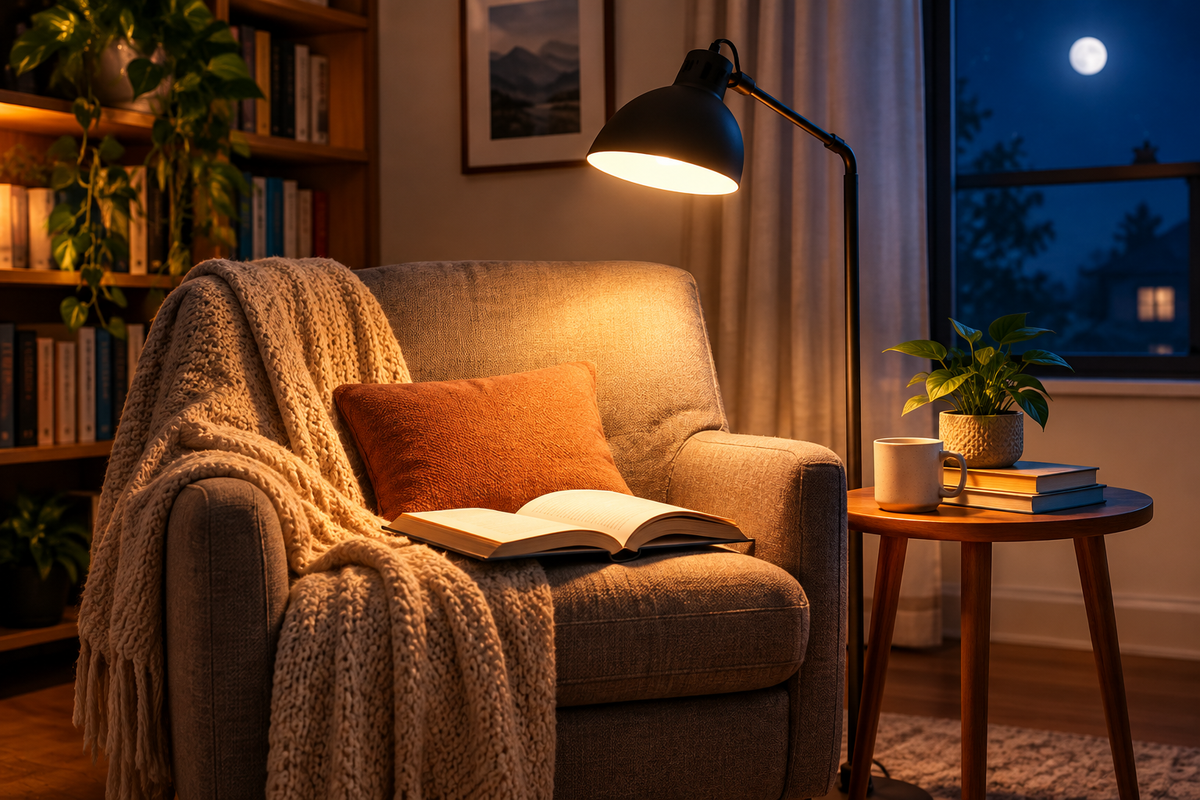

Circadian lighting works by controlling the color and intensity of light your eyes receive at different times of day, because a specific set of cells in your retina uses that information to set your body’s internal clock. It isn’t a wellness buzzword, it's a direct application of how the human visual system evolved to track daylight. Here’s the mechanism, step by step.
How Your Eyes Detect Light
Most people know that rods and cones in the retina let you see shape, color, and detail. But there’s a third type of photoreceptor involved in vision-adjacent processing: intrinsically photosensitive retinal ganglion cells, or ipRGCs. These cells don’t contribute much to what you consciously see. Instead, they measure the overall color and brightness of the light in your environment and report it straight to your brain’s master clock.
ipRGCs contain a photopigment called melanopsin, which is most sensitive to light around 480 nanometers the blue part of the visible spectrum, roughly the color of a clear midday sky. This is the single most important fact in circadian lighting design: your circadian system doesn’t respond much to red or amber light, but it responds strongly to blue-enriched light, whether that blue light comes from the sun, a laptop screen, or a cool-white LED bulb.
How Your Brain Sets Your Body Clock
The signal from your ipRGCs travels along a pathway called the retinohypothalamic tract to a small cluster of roughly 20,000 neurons in the hypothalamus called the suprachiasmatic nucleus, or SCN. The SCN is often described as the body’s master clock because it coordinates the timing of dozens of downstream processes including melatonin release from the pineal gland, cortisol release from the adrenal glands, core body temperature, and even the timing of peripheral “clocks” in organs like the liver and gut.
Left with no light cues at all, the SCN still keeps time on its own research using tightly controlled light exposure has found the average intrinsic human circadian period runs slightly longer than 24 hours. Because of that slight mismatch, your body relies on daily light exposure to reset the clock and keep it aligned with the actual 24-hour day. Light is the dominant “zeitgeber” , the primary external cue the SCN uses for that daily reset, ahead of other cues like meal timing or activity.
How Light Affects Melatonin and Cortisol
Once the SCN registers bright, blue-rich light, it sends signals that suppress melatonin production and support the release of cortisol the hormone most responsible for morning alertness, with levels that typically peak shortly after waking in what’s known as the cortisol awakening response. As light in the blue range fades in the evening, that suppression signal fades too, allowing melatonin to rise naturally in the hours before your usual bedtime, priming your body for sleep.
This is why circadian lighting design isn’t just about dimming lights at night. It’s about deliberately controlling the color temperature how much blue-wavelength content is present because that’s the variable your ipRGCs are actually built to detect.
Why Color Temperature Matters
Color temperature, measured in Kelvin, is a simple way to describe the mix of wavelengths in a light source. Lower Kelvin numbers (1800K–2700K) correspond to warm, amber-heavy light with little blue content similar to firelight or a sunset. Higher Kelvin numbers (5000K–6500K) correspond to cool, blue-white light similar to daylight at noon.
Because ipRGCs respond most strongly to the blue end of the spectrum, a 6000K bulb in the morning delivers a much stronger “daytime” signal to your SCN than a 3000K bulb does, and a 1800K bulb in the evening delivers a much weaker one than a standard 2700K–3000K “warm white” LED. This is the entire logic behind multi-mode circadian bulbs: a true high-Kelvin mode for mornings, a balanced mid-Kelvin mode for daytime living, and a true low-Kelvin mode for evenings rather than one fixed color used around the clock.
Why Kelvin Isn’t the Whole Story
Color temperature is a useful shorthand, but researchers have found that two bulbs at the same Kelvin rating can still have meaningfully different effects on the circadian system, depending on the precise shape of their light spectrum.To capture this more precisely, lighting scientists use metrics like equivalent melanopic lux (EML), which weights a light’s spectral output specifically by how strongly it activates melanopsin-containing ipRGCs, and Circadian Stimulus (CS), a related measure tied to expected melatonin suppression. These metrics are now built into standards like WELL v2 and the updated ISO/CIE 8995-1 lighting guidance, which recommends keeping melanopic lux low under roughly 50 in bedrooms at night.
For a home buyer, the practical takeaway is simple even without the technical metrics: the lower the Kelvin and the more blue-wavelength content a bulb removes, the weaker its “daytime” signal to your circadian system which is exactly what you want in the hours before bed.
How to Use Circadian Lighting Throughout the Day
A circadian lighting system, in practice, is just a way of deliberately controlling this input across the day:
Morning
Bright, high-Kelvin light (5000K–6500K) supports a bright start to the day, helping promote energy, focus, and alertness.
Midday & Early Evening
Balanced, mid-Kelvin light (3500K–4000K) supports focus and productivity without unnecessary blue-light exposure as natural daylight begins to fade.
Night
Warm, low-Kelvin light (1800K–2200K) creates a softer environment for relaxing and winding down, helping support the body's natural transition toward sleep.
This is the reasoning behind Kind Lights’ three-mode design: THRIVE (6000K), FLOW (3500K), and REST (1800K) switchable from your existing wall switch. For the full daily arc and room-by-room recommendations, see the complete circadian lighting guide and the benefits of circadian lighting. For how high bulb quality (CRI and flicker) factors into the experience beyond color temperature alone, see understanding CRI and LED flicker.
Share:
What Is the Best Lighting for a Bedroom?
Does Blue Light Affect Sleep? What the Science Says